

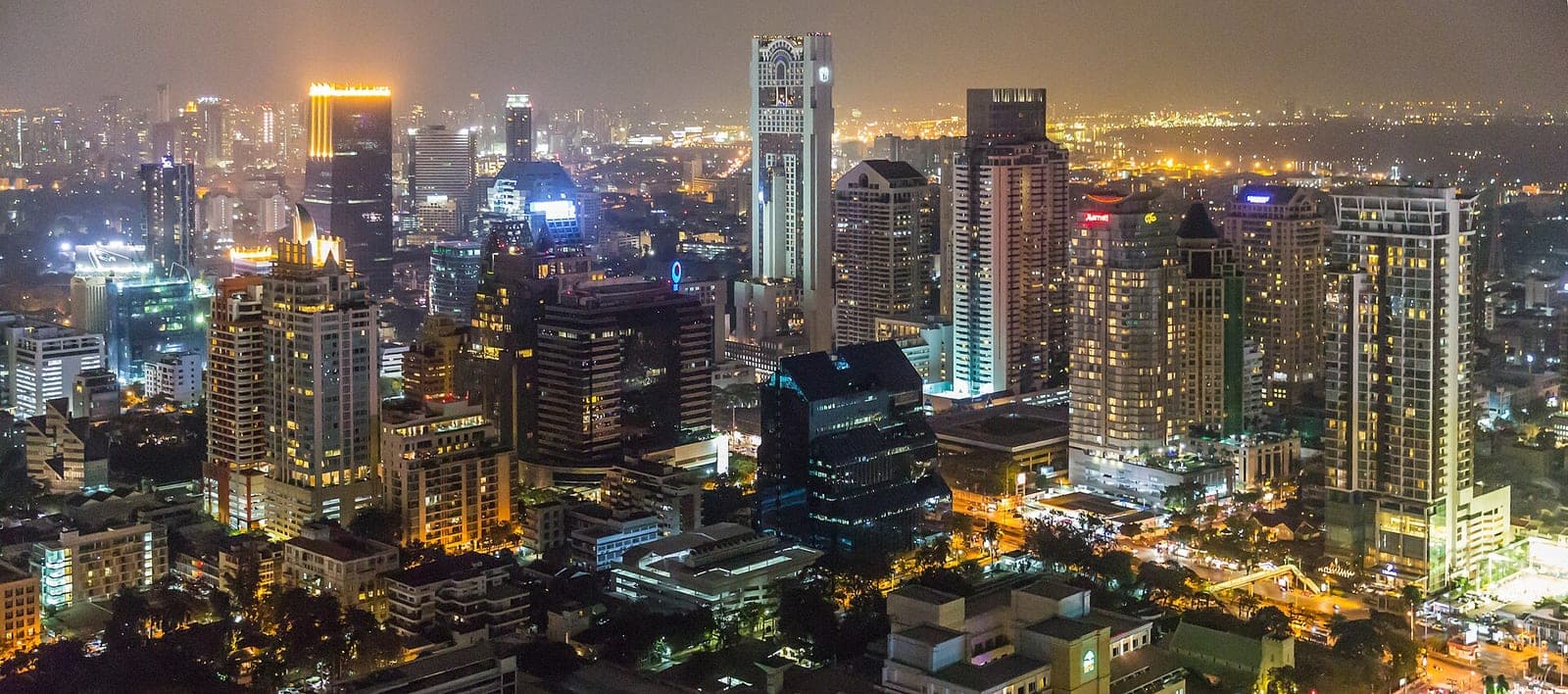



















Malaysia is a country of about 34 million people split between the Malay peninsula and the northern third of Borneo, and it is the best-run place in this guide: clean cities, working infrastructure, hospitals Westerners fly in for, and the best English in the region after the Philippines. It is also, for the purpose of this website, a three-night city rather than a two-week destination. Kuala Lumpur is the only place we cover, and we rank it tier three, honestly and without much agonizing.
What Malaysia is for a man on this trip. KL's nightlife lives in two clusters twenty minutes apart. Changkat Bukit Bintang is the restaurant-and-bar street — a genuinely enjoyable strip of two- and three-story shophouse bars, rooftop terraces, sports pubs and late-night clubs, busy Thursday to Saturday and pleasantly civilized the rest of the week. Jalan P. Ramlee, in the shadow of the Petronas Towers, is the older club street: big rooms, live bands, a mixed local and expat crowd, and a more direct scene than Changkat's. Beyond those two streets there are hotel lounges, a large and discreet KTV trade, and not much else that concerns a visitor. KL is a fine place to break a long journey, to see a doctor or a dentist, to eat extremely well and to spend three nights out; it is not a place we would send a man for a fortnight, and the rankings page shows where it sits against Pattaya and Angeles City.
The women and the culture. Malaysia is multi-ethnic in a way none of the other countries here are: a Malay majority of roughly 58%, other indigenous peoples making up around a tenth more, about 23% ethnic Chinese and about 7% ethnic Indian. That matters socially. Islam is the state religion and Malays are Muslim by legal definition, with Sharia courts covering family and morality law for Muslims only — which includes khalwat, the offense of a Muslim being in "close proximity" with an unrelated person of the opposite sex. In practice this is enforced rarely and unevenly and essentially never against a foreigner, but the woman would be the one exposed, and any visitor dating a Malay Muslim woman needs to understand that before he starts. Chinese and Indian Malaysians are under no such constraint, live much as their counterparts do in Singapore or Hong Kong, and are the crowd you will actually meet in the Changkat bars. Across all communities the culture is educated, urban, prosperous and much closer to Western dating norms than Thailand or Cambodia — which means the age gap and the economic asymmetry that carry a man in Pattaya carry him nowhere at all in Kuala Lumpur. Bring the same manners you would use in Chicago and you will do fine. Culture and respect has the wider version.
Money. The currency is the ringgit (RM), around RM4.3 to the dollar as of August 2026. Malaysia is a card country: contactless works nearly everywhere, Grab is app-paid, and you need less cash here than anywhere else in this guide. The exception is drink prices. Malaysia taxes alcohol at close to Singaporean levels, and a bottle of Tiger in a Changkat bar runs RM20–30 ($4.70–7), which is double Bangkok and triple Phnom Penh; happy hours and jugs are how locals survive it. Everything else is good value: a nice central hotel room $50–90, a superb bowl of laksa $2–3, KLIA Ekspres to the airport $12. A week costs $1,300–2,200 excluding flights, mostly because of the bar bill.
Getting there and around. No US nonstop, and the routings are long: 21–25 hours door to door via Tokyo, Seoul, Taipei, Hong Kong or Singapore from the West Coast, or via Doha and Dubai from the East, for $950–1,600 round trip in economy. Kuala Lumpur International (KUL) is 55 km south of the city and the KLIA Ekspres train covers it in 28 minutes for about RM55; a Grab is $15–20 and takes an hour in traffic. Once you are in town, KL has the best urban transport in Southeast Asia after Singapore — MRT, LRT, monorail and a free city-center bus loop — and Grab fills every gap for two or three dollars. AirAsia's home base is here, which makes Malaysia the cheapest hub in the region for onward hops: Bangkok, Phuket, Bali, Saigon and Manila are all $60–150 round trip. That is the strongest practical argument for putting KL in an itinerary at all. See flights from the US.
Safety and the law. Malaysia is among the safest countries in Asia for a visitor. Violent crime against foreigners is rare, the police are professional by regional standards, the hospitals are excellent and the tap water problem is smaller than elsewhere. Ordinary caution applies: bag snatching from motorbikes happens in KL, credit-card skimming is reported, and the Bukit Bintang area has the usual late-night nuisances. Two hard lines. Drugs: trafficking has historically carried a mandatory death sentence, made discretionary by a 2023 reform but still capital, and possession brings long prison terms — there is no gray area here at all. And Sharia law, which applies to Muslims only but affects anyone spending time with a Malaysian Muslim; be discreet, be respectful, and do not put a woman in a position she cannot explain. Alcohol is legal for non-Muslims and sold openly in KL, Penang and the tourist areas, though the conservative east-coast states are effectively dry. The Foreign Ministry advisories for the coastal areas of eastern Sabah are worth reading if you plan to go diving; nothing in this guide sends you there. See safety.
When to go. Kuala Lumpur is two degrees north of the equator and hot, humid and prone to an afternoon thunderstorm every single day of the year, so the weather is barely a factor — the wettest months are roughly March to April and September to November, and they are not a reason to reschedule. Ramadan is the thing to plan around: for a month, many bars and clubs cut hours or close, alcohol is harder to buy, live music stops, and the mood is subdued until the Hari Raya holiday. In 2027 that runs from roughly 8 February to 9 March. Chinese New Year, in late January or February, closes a lot of Chinese-owned businesses for several days and is a lovely time to be in the city if you like a party in the street.
How it has changed, and where it is now. KL spent the 2000s and 2010s becoming a serious international city — the Petronas Towers, the transport network, the medical tourism, the food scene that people now fly in for. The nightlife has gone the other way. The old Jalan P. Ramlee of expat legend is quieter than it was, the raid-and-crackdown cycle around KTVs and late licenses ebbs and flows with the politics of the day, and the drinks have got steadily more expensive as duty has risen. Malaysia has become an easier country to live in and a harder one to go out in, and that trade is fine for most of its residents and awkward for a visitor on a nine-night trip. As of August 2026 our advice stands: three nights in KL at the front or back of a Thailand trip is a pleasure. Three weeks is not. Read how to choose a destination if you are still deciding.
Best for
- a stopover of two or three nights
- excellent English
- food
- medical and dental trips
- cheap onward flights on AirAsia
Best months
Any — Kuala Lumpur is hot and humid year-round with a daily afternoon storm. Plan around Ramadan, when bars cut hours and the mood is subdued, and expect Chinese New Year to close a lot of businesses for several days.