

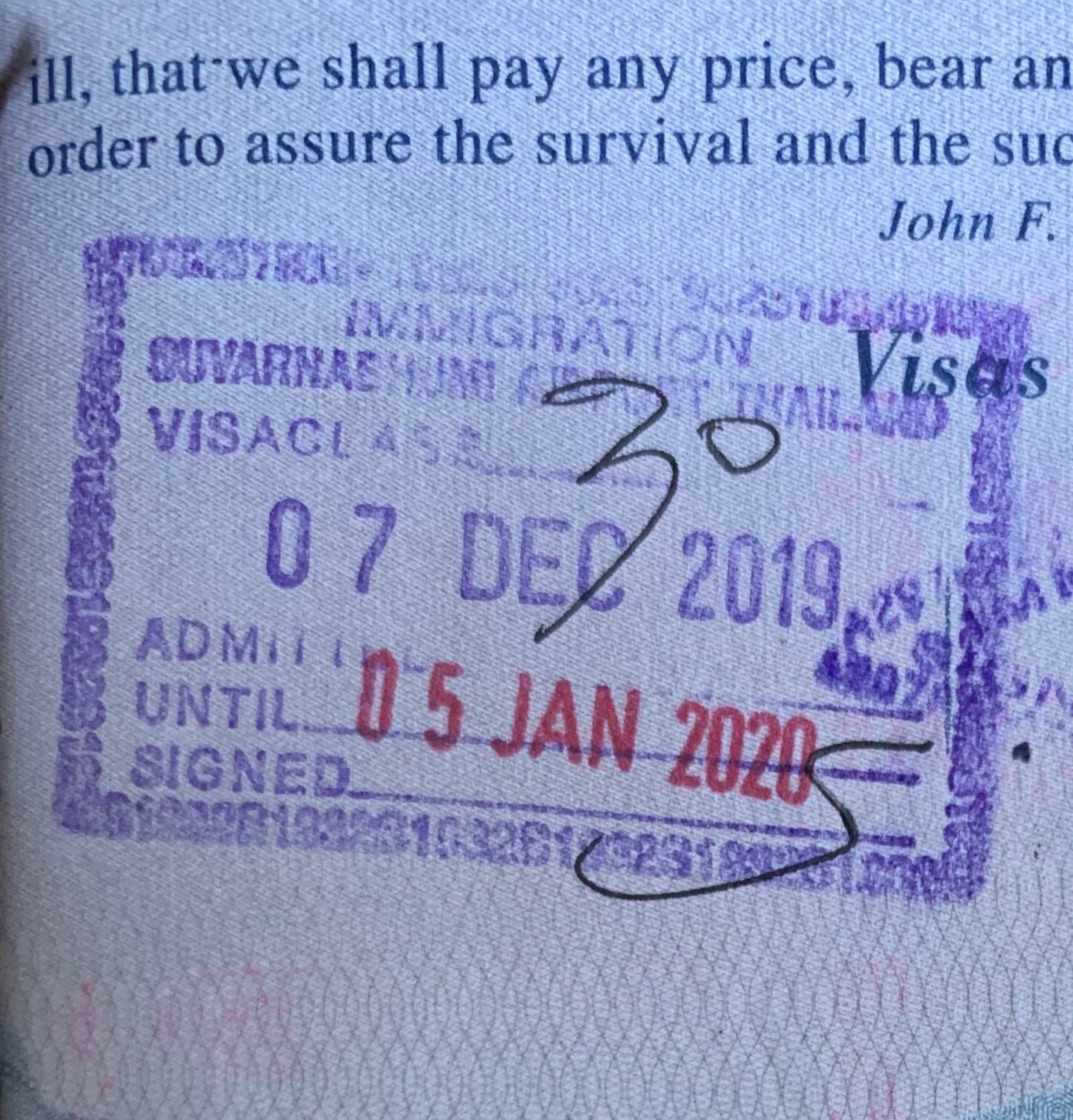
A US passport gets you into every country in this guide for at least 30 days with no embassy visit, but the paperwork differs in each one: Thailand, the Philippines and Malaysia stamp you in free, Cambodia and Indonesia sell a visa at the airport, and Vietnam wants an e-visa approved before you board. This page is the country-by-country version, current as of August 2026 and hedged where the rules are moving — which, in Thailand's case, they are.
Two things up front. First, every country on this list wants your passport valid for six months past your arrival date and at least one blank page; airlines check this at the US departure gate and will deny boarding. Second, most of them want proof you are leaving — an onward or return ticket — and again it is the airline at LAX or JFK, not the immigration officer in Bangkok, who is most likely to ask. More on both below.
What does a US passport get you at each border?
| Country | On arrival | Cost | Extension | Arrival form | Gotchas |
|---|---|---|---|---|---|
| Thailand | Visa exemption, 60 days (being cut to 30 in 2026) | Free | +30 days at immigration, $58 (฿1,900) | TDAC online, free, within 3 days before | Overstay ฿500/day; land-border entries capped |
| Philippines | Visa-free, 30 days | Free | +29 days, then 1/2/6 months, up to 36 months | eTravel online, free, within 72 hours before | Onward ticket enforced at check-in; ACR I-Card after 59 days |
| Cambodia | Visa on arrival, 30 days | $30 cash (VOA) / $36 (US$36) (e-visa) | +30 days via an agent | e-Arrival card online, free, within 7 days before | Bring clean US bills and a passport photo for VOA |
| Vietnam | E-visa required before travel, up to 90 days | $25–50 (US$25 single / US$50 multiple entry) | Not normally extendable; leave and re-enter on a multiple-entry e-visa | None beyond the e-visa | Copycat "official" websites; entry port must match |
| Indonesia (Bali, Jakarta) | Visa on arrival / e-VOA, 30 days | Rp 500,000 (about $30) | One +30 days, Rp 500,000 | All Indonesia arrival declaration; Bali levy Rp 150,000 | Onward ticket checked; strict on drugs and vapes |
| Malaysia | Visa-free, 90 days | Free | Rarely needed | MDAC online, free, within 3 days before | Six months' passport validity, no exceptions |
All figures as of August 2026. Fees change; the shape of the rules changes less often.
Thailand: 30 days or 60 — and which applies to you?
Thailand gave US passports a generous 60-day visa exemption from July 2024, and for two years that was the rule. On 19 May 2026 the Thai cabinet approved rolling it back to 30 days for the US and roughly 90 other countries, citing abuse of the scheme. The change takes effect 15 days after publication in the Royal Gazette; as of our last check the publication date had not been confirmed, so you may still be stamped in for 60. Treat 30 as the planning number and check the day you fly. A planned "ETA" pre-registration for visa-exempt travelers was announced back in 2024 and has repeatedly slipped; assume it may appear without much notice.
What does not change:
- The Thailand Digital Arrival Card (TDAC). Mandatory since May 2025, free, filed online at the immigration department's site within three days before you land. Airlines and immigration both check for it. Do it from the hotel in Taipei or the lounge at LAX; it takes five minutes and a photo of your passport.
- The 30-day extension. Whatever you are stamped in for, one extension of 30 days is available at any immigration office for $58 (฿1,900). For Pattaya that is the Jomtien office on Soi 5; for Bangkok it is Chaeng Watthana. Bring your passport, a photo, copies of the photo page and entry stamp, and the TM30 address slip your hotel files. Go early, dress like an adult, and it is done before lunch.
- Overstay fines. ฿500 a day, capped at ฿20,000, paid in cash at departure. Over 90 days and you are banned for at least a year. It is never worth it; the extension costs less than four days of fine.
- The DTV. The Destination Thailand Visa, a five-year multiple-entry visa allowing 180 days per visit, exists for remote workers and people enrolled in "soft power" activities such as Muay Thai or cooking courses. It costs ฿10,000 and a stack of documents. If you are thinking about a winter in Pattaya every year, read up on it; for a two-week trip, ignore it. The Retiring in Southeast Asia: the visas, the money and the reality guide covers the longer-stay options properly.
Thailand's e-visa portal exists for the 60-day tourist visa (TR) if you want more time than the exemption gives you. Most visitors never need it.
The Philippines: 30 days, then as long as you like
The Philippines is the easiest long stay in the region for an American. You get 30 days visa-free on arrival at Manila or Angeles City's Clark airport, and then you simply extend, repeatedly, at any Bureau of Immigration (BI) office — there is one in Angeles, one in Clark, one in Makati, one in Cebu.
The sequence, as of August 2026:
- First extension, 29 days, taking you to 59 days total: $53–56 (₱3,030–3,150), done in an hour or two.
- Beyond 59 days you extend in one-, two- or six-month blocks and must buy the ACR I-Card (Alien Certificate of Registration), a plastic ID that costs $50 plus a small express fee and is collected a few weeks later. Reported all-in cost of the first post-59-day extension is around ₱9,000–10,000 including the card.
- Up to 36 months total on one entry, after which you leave and the clock resets.
Expect a modest "express lane" fee at most offices and bring your own photocopies. Agents in Angeles will do the trip for you for a small fee; plenty of expats use them.
Two rules catch Americans out. The onward ticket: the Philippines requires proof of onward travel within your authorised stay, and it is the airline at your US departure gate that enforces it. A refundable or cheap budget-airline ticket to anywhere satisfies them; do not turn up at SFO on a one-way. And the eTravel form: a free online registration at the government's etravel.gov.ph within 72 hours of arrival, replacing the old paper arrival card. Screenshot the QR code.
Cambodia: e-visa or visa on arrival?
Both get you 30 days, and both work at Phnom Penh's new Techo International Airport (which replaced the old city airport in 2025).
- Visa on arrival is $30 in US cash for a tourist visa (T class), plus one passport photo. Bills must be clean and undamaged — Cambodian banks and officials reject torn or marked dollars. The queue is usually short.
- The e-visa at the official evisa.gov.kh portal is $30 plus a $6 processing fee, approved in about three working days, valid for three months from issue for a single entry of 30 days. It saves the queue and the photo and is what we do. Only use the .gov.kh site; third-party sites charge double.
- Everyone flying in also files the free e-Arrival card at arrival.gov.kh within seven days before landing.
Extending is unusual in that you do not go to immigration yourself: travel agents around Street 104 & the Riverside handle a one-time 30-day tourist extension for a reported $45–60 including their fee, taking three to five days. If you think you will stay past 60 days, get the $35 "ordinary" (E class) visa instead, which can be extended for months or a year through the same agents.
Vietnam: the 90-day e-visa and the copycat problem
Americans are not on Vietnam's visa-exemption list, so every trip starts with the e-visa, applied for online before you fly. Since August 2023 it has been issued for up to 90 days, single entry for $25 or multiple entry for $50, and it is the only visa you will ever need for Ho Chi Minh City or Hanoi.
The process is straightforward but unforgiving: upload a passport scan and a plain photo, state your entry port exactly (Tan Son Nhat for Saigon, Noi Bai for Hanoi) and your dates, pay by card, wait three to five working days and print the PDF. The entry port must match — land at the wrong airport and you will be refused.
If you plan to bounce between Saigon and Phnom Penh — a very good two-week itinerary — pay the $50 for multiple entry. The e-visa cannot normally be extended in-country; the answer is to leave and come back on the multiple-entry version.
Indonesia: the visa on arrival and the Bali levy
For Bali and Jakarta a US passport buys a visa on arrival for Rp 500,000 (about $30) at the airport, or the same thing online in advance as an e-VOA through the immigration department's Molina portal, which lets you use the e-gates at Denpasar. Either gives 30 days and can be extended once, for another 30 and another Rp 500,000, either in person at an immigration office (two visits, a week apart) or through one of Bali's many visa agents for a markup.
On top of that, Bali charges a provincial tourist levy of Rp 150,000 (about $9) per entry, paid online through the Love Bali site or at the airport, and Indonesia now asks arrivals to complete its "All Indonesia" electronic customs and health declaration before landing; as of August 2026 the exact mechanics were still being tidied up, so check your airline's emails. A passport with six months' validity and an onward ticket are required, and Indonesian immigration does ask.
Indonesia's drug laws are among the harshest on earth and its customs officers take vapes and e-liquids seriously. The Safety in Southeast Asia: what actually goes wrong, and what to do about it page has the detail.
Malaysia: 90 days and a form
Kuala Lumpur is the easy one. US passports get 90 days visa-free, no fee, no visa. The single requirement is the Malaysia Digital Arrival Card (MDAC), a free online form at the immigration department's site submitted within three days before you arrive. Have the confirmation email on your phone at the e-gate. Six months' passport validity is enforced without sympathy.
Do I really need an onward ticket?
Usually, and it is the airline that cares. US carriers and their Asian partners are fined if they carry a passenger a country refuses, so check-in staff at LAX, SFO, SEA and JFK are trained to ask for proof of onward travel on one-way bookings to the Philippines, Indonesia and Thailand in particular. Options, cheapest first:
- Book your trip as a round trip or an open-jaw (into Bangkok, out of Manila). Solved.
- Buy a cheap one-way on AirAsia or Cebu Pacific to the next country on your list; you were going to anyway. See Flights from the US to Southeast Asia: routes, airlines and what they cost.
- Buy a fully refundable ticket and cancel it after you land — legal, and a bit of a hassle.
- The "onward ticket rental" services that issue a real 48-hour reservation for a few dollars. They work; we prefer the real cheap flight.
What is a visa run, and should I do one?
A visa run is leaving a country purely to come back with a fresh stamp. It used to be a Thai institution — minivans from Pattaya to the Cambodian border at Poipet and back in a day — and it is now the behaviour the May 2026 rule change is explicitly aimed at. Thailand already caps visa-exempt land-border entries at two per calendar year, and immigration officers at airports question travelers with a string of back-to-back exemptions; refusals at Suvarnabhumi are reported every month.
Our advice, in order: extend at immigration (Thailand, Philippines, Indonesia, Cambodia) rather than run; if you need longer still, get the proper visa (Thai TR or DTV, Philippine extensions, Cambodian E class); and if you must reset, fly somewhere you actually want to be — Phnom Penh from Bangkok is seventy minutes and $120–250 (US$120–250) round trip — and stay a few nights. A passport full of same-day turnarounds is a red flag in every country on this page.
One last note for the men who come back a second time: if you are bringing her home rather than staying out here, that is a completely different process, covered in Bringing her home: the K-1 and CR-1 visas, explained.