

The medical care available to a foreigner in Bangkok, Manila or Pattaya is better and cheaper than most Americans expect — private hospitals with English-speaking doctors, short waits and prices a fraction of US ones — and the two things that ruin it are having no insurance and having the wrong insurance. This page covers what to arrange before you fly, what the policy has to say, and where to go at three in the morning when something has gone wrong. It is general information from public health guidance as of August 2026, not medical advice; a travel clinic exists for exactly that.
What does travel insurance actually have to cover?
Four things, in descending order of how badly you will regret their absence.
- Emergency medical treatment and hospitalization, with a limit in the hundreds of thousands rather than the tens of thousands. A week in intensive care in a Bangkok private hospital is not cheap by local standards.
- Medical evacuation and repatriation. This is the expensive one and the reason to buy a policy at all. An air ambulance from a provincial hospital in the Philippines to Manila, or from Cambodia to Bangkok, runs into five and six figures. Look for evacuation cover of at least $100,000; $250,000 is better, and it is rarely the expensive part of the premium.
- A pre-existing condition waiver if you have anything ongoing — blood pressure, diabetes, a heart history. These are usually only available if you buy within a couple of weeks of your first trip payment, which is the best argument there is for buying insurance the day you book the flight.
- Cover at your actual age. Premiums step up at 65 and again at 70, and some policies simply stop. Read the age table before you get attached to a quote.
Budget $50–150 (US$50–150) for a month of decent cover. Medicare does not cover you outside the United States, full stop, and most US employer plans reimburse only emergencies, after you have paid up front and filed a claim in English from a hotel room. Assume you are uninsured until you have bought something.
Why the motorbike clause matters more than anything else on this page
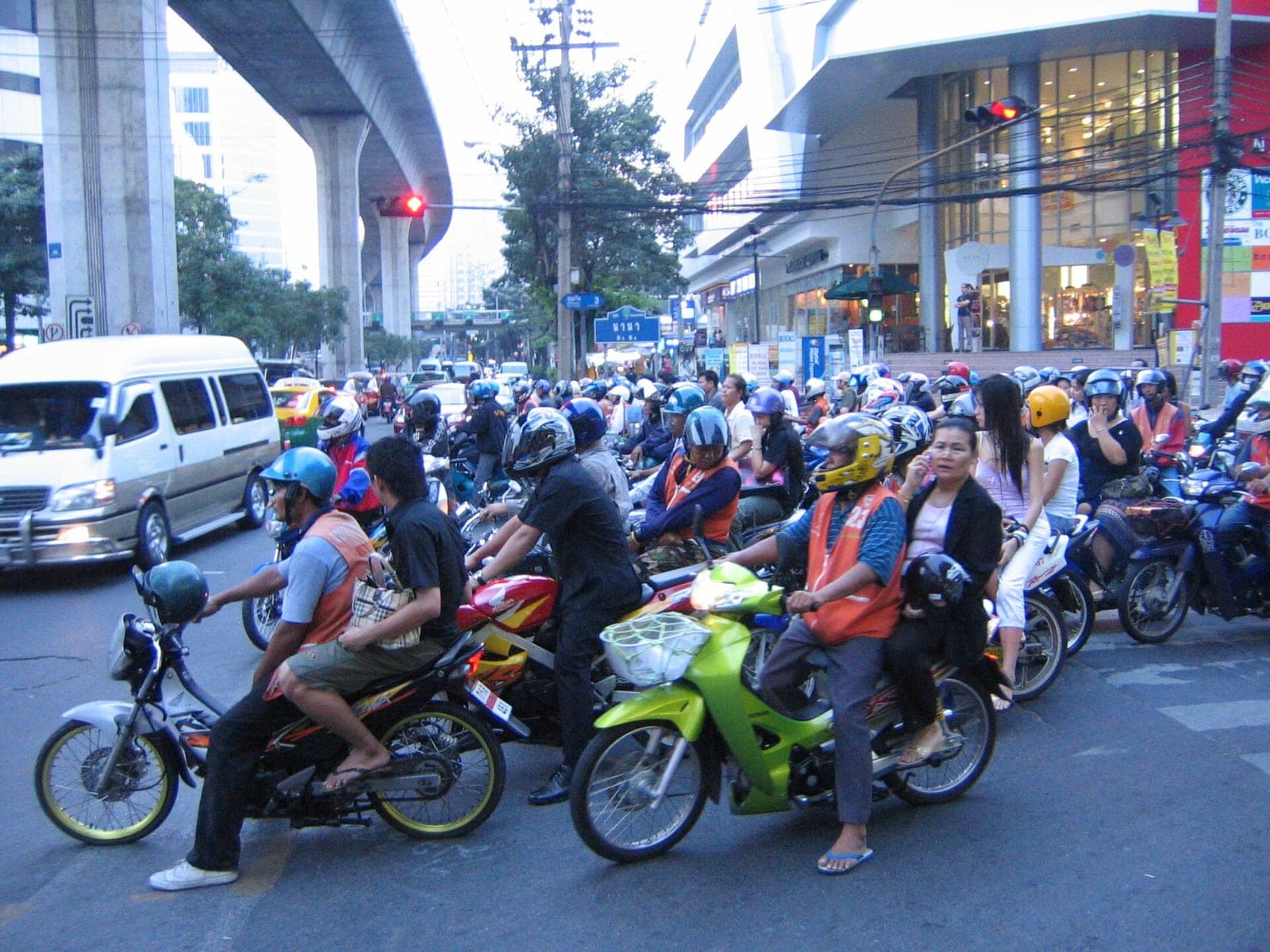
Because the scooter is the single most likely thing to hurt you on this trip. Not crime, not food, not the bars: the scooter.
Thailand has for years been among the deadliest countries in the world for road deaths per head, and the great majority of those deaths are on motorcycles; Vietnam and the Philippines are not far behind. Add a foreigner who last rode a bike thirty years ago, an unfamiliar road, left-hand traffic in Thailand and a beer, and the odds are what they are. Every long-term resident of Pattaya or Angeles City can name someone who lost a leg or worse.
If you are going to ride anyway:
- Get the paperwork right. A motorcycle endorsement on your home license plus an International Driving Permit covering motorcycles. Thai police stop foreigners on bikes routinely and a rental shop will hand you keys without asking for any of it — that is their business model, not your legal cover.
- Wear a helmet, every time, including the two-minute ride back to the hotel. It is the law in Thailand and it is enforced with fines.
- Do not drink and ride. Beyond the obvious, it voids your policy twice over.
- Photograph the bike before you take it, and never hand over your passport as a deposit. Scams: the ones that are still running, and how to handle each explains why.
Honestly, the simplest answer is not to. A Grab car is $2–4 (฿70–130 / ₱120–250 / ₫50,000–100,000), a baht bus in Pattaya is $0.45–0.60 (฿15–20), a tricycle in Angeles is $1–1.8 (₱60–100), and none of them will put you in a wheelchair.
What vaccines and medicines do you need?
See a travel clinic four to six weeks before you fly, because some courses take time. As of August 2026 the CDC's guidance for the countries on this site looks like this:
| Recommended for most travelers | Judged by risk | |
|---|---|---|
| Routine | MMR, tetanus/diphtheria, polio, influenza, shingles, COVID-19 | — |
| Thailand | Hepatitis A, hepatitis B, typhoid | Japanese encephalitis (long or rural stays), rabies |
| Philippines | Hepatitis A, hepatitis B, typhoid | Japanese encephalitis, rabies, cholera for some |
| Cambodia / Vietnam | Hepatitis A, hepatitis B, typhoid | Japanese encephalitis, rabies |
| Indonesia | Hepatitis A, hepatitis B, typhoid | Japanese encephalitis, rabies |
| Malaysia | Hepatitis A, hepatitis B, typhoid | Japanese encephalitis, rabies |
The CDC has a standing global notice on measles and asks all international travelers to be current on MMR. There is no yellow fever risk in any of these countries, but proof of vaccination is required if you arrive from a country that has it.
Malaria does not apply to you in any city covered on this site. The CDC recommends prophylaxis only for Thailand's provinces bordering Myanmar, Cambodia and Malaysia, and in the Philippines for Palawan and the Mindanao island group; there is no transmission in Bangkok, Pattaya, Manila, Angeles, Phnom Penh, Saigon or Bali's resort areas.
Dengue does apply, everywhere, and there is nothing to take for it. It is spread by a mosquito that bites during the day, it peaks in the rainy season, and it puts perfectly fit men in hospital for a week with fever, joint pain and a crashing platelet count. Repellent morning and dusk, plus air conditioning, is the whole defense. As of August 2026 the CDC also had a standing Zika notice for Bali following cases in returning travelers.
Rabies is present in Thailand, the Philippines, Cambodia and Vietnam, in street dogs and in the macaques at temples and viewpoints. If you are bitten or scratched, wash the wound with soap and running water for a full fifteen minutes and go to a major hospital the same day. Do not wait — and because the CDC specifically warns about counterfeit rabies vaccine circulating in the Philippines, do not get it anywhere but a large, reputable hospital.
Where do you go if something goes wrong?
Long-standing private hospitals, all of which treat foreigners as routine business, as of August 2026. Confirm before you need one; hospitals move and rebrand.
| City | Usual first stop | Notes |
|---|---|---|
| Bangkok | Bumrungrad International, Samitivej Sukhumvit, BNH | Among the best-known international hospitals in Asia; deal with foreign insurers directly |
| Pattaya | Bangkok Hospital Pattaya | The default for expats on this coast; Pattaya Memorial is closer to the center |
| Phuket (Patong) | Bangkok Hospital Phuket | Patong clinics for minor things, the hospital for anything real |
| Angeles City | The Medical City Clark, Angeles University Foundation Medical Center | Sacred Heart is also widely used; Manila for anything major |
| Manila | Makati Medical Center, St. Luke's BGC | Both are used by the diplomatic community |
| Cebu | Chong Hua, Cebu Doctors' University Hospital | |
| Phnom Penh | Royal Phnom Penh Hospital, Sunrise Japan Hospital | Serious cases are commonly evacuated to Bangkok |
| Ho Chi Minh City | FV Hospital, Franco-Vietnamese Hospital | |
| Bali | BIMC Siloam | Evacuation to Singapore for major trauma |
Two practical points. Private hospitals want money or a guarantee before they treat you — a credit card at admission, or your insurer's authorization, which is why the policy number in your phone matters. And keep every receipt, in English if you can get it; claims are paid on paperwork.
Emergency numbers, ambulance first: 1669 in Thailand, 911 in the Philippines, 119 in Cambodia, 115 in Vietnam, 118/119 in Indonesia, 999 in Malaysia. In practice, in a city, a taxi or a Grab to the private hospital is often faster than waiting for an ambulance. Safety in Southeast Asia: what actually goes wrong, and what to do about it has the full table.
What can you buy in a pharmacy?
More than at home, and cheaply. Thailand has Boots and Watsons in every mall plus thousands of independents; the Philippines has Mercury Drug on what feels like every corner. Pharmacists are well trained, speak enough English, and will sell you most things after a conversation.
Antibiotics are the exception: Thailand tightened dispensing rules and they are pharmacist-controlled rather than sitting on the shelf, and the Philippines enforces prescriptions more strictly than it used to. Do not self-prescribe them anyway — a doctor's consultation at a private hospital costs less than a bar tab.
One caution. Buy from a chain or an established pharmacy, never from a market stall, a street vendor or a bar. Counterfeit medication is a real problem across the region, and the counterfeit most often sold to Western men in nightlife areas is erectile-dysfunction medication — available as a cheap licensed generic from any actual pharmacy.
Bringing your own prescriptions
Bring what you take in its original labeled packaging, with a copy of the prescription or a signed letter from your doctor, in a quantity that reads as personal use — 30 days is the standard rule of thumb and covers any normal trip. Carry it in your hand luggage.
The trouble is never ordinary medication; it is controlled categories. Thailand classes amphetamine-based ADHD medication as a narcotic and it is effectively prohibited; strong opioid painkillers and benzodiazepines are controlled and want documentation and, in some cases, prior permission. Vietnam, Indonesia and Malaysia are similarly strict about psychotropics and codeine. If anything you take falls in those groups, check the destination's health authority rules before you fly — the customs desk is the wrong place to find out.
Bring a written list of the generic names and doses of anything you take daily. Brand names do not travel; generic names do, and a doctor anywhere in the region will recognize them.
Heat, water and the drink
The hot season runs roughly March to May, and Bangkok and Manila regularly sit above 35°C (95°F) with humidity that pushes the heat index far higher. For a man over fifty, particularly one on blood-pressure medication or a diuretic, that is a genuine risk rather than an inconvenience.
The rules are dull and they work: water constantly at $0.25–0.50 (฿7–15 / ₱15–25 / ₫5,000–10,000) a bottle, electrolyte sachets from any convenience store, the middle of the day indoors, a hat, and an honest accounting of alcohol. The men who end up on a drip in a Pattaya hospital are usually there because of two days of sun and beer rather than anything exotic.
Do not drink the tap water anywhere on this list; ice in cities is factory-made and generally fine. Air quality is worth a thought if you have asthma — northern Thailand and Bangkok have a bad smoke season roughly January to April, and Manila and Jakarta have year-round traffic pollution. Bring your inhaler.
Sexual health, stated plainly
This is a site about meeting women, so we will be clinical about it rather than coy.
HIV is present across the region. Roughly one percent of Thai adults live with HIV according to UNAIDS, Cambodia's rate is lower, and the Philippines — historically a low-prevalence country — has the fastest-growing epidemic in the Western Pacific, with new infections rising steeply over the past decade and public health authorities treating it as an emergency. Other sexually transmitted infections are more common still and most of them have no symptoms in men.
What follows from that is simple and non-negotiable:
- Use condoms. They are sold in every 7-Eleven, Watsons and Mercury Drug in the region. Local sizing runs small; bring your own if that applies to you.
- PrEP is legal, cheap and widely available in Thailand and the Philippines through sexual-health clinics and NGO programs. If your trip involves any risk at all, talk to your own doctor about it before you fly.
- PEP works only if you start it within 72 hours of a possible exposure. If something happens, go to a large hospital or a sexual-health clinic the same day. Not tomorrow.
- Get tested when you get home, as a matter of routine, and again at three months. This is normal adult maintenance, not an accusation.
Alcohol is what makes people careless. Decide what you are doing while you are sober.
What to do in the four weeks before you fly
Book the travel clinic. Buy the insurance the same day you buy the flight, so the pre-existing waiver is available. Get a dental check, because a Thai dentist is excellent but a root canal is a bad way to spend a Tuesday in Pattaya. Fill your prescriptions with enough for the trip and get the doctor's letter. Photograph your insurance card, policy number and medication list and email them to yourself.
Then do the enjoyable part: work out where you are going, book the hotel, and start the conversations. Most men who come back a second time had been  talking to someone for a few weeks before they landed — see Online dating before you fly: how the smart guys land with a date already booked.