

Thailand and the Philippines are the two countries in Asia with nightlife scenes built for visiting Western men, and the choice between them comes down to a single trade: Thailand is the better holiday, the Philippines is the better conversation. Everything else in this guide is detail on that sentence.
We send first-timers to two cities, Pattaya and Angeles City, one in each country, and we mean it — the rest of the region is ranked honestly against them. So this page is really the country-sized version of Pattaya vs Angeles City: which one first?, with the flights, visas, food, beaches and culture that the city comparison leaves out. Read both before you book.
The short version
| Thailand | Philippines | Winner | |
|---|---|---|---|
| Size of the scene | Pattaya, Bangkok, Phuket, plus a dozen smaller towns | Angeles City, Manila, Cebu, Subic Bay | Thailand |
| English | Patchy; good on the bar streets, thin behind them | Official language; near-universal | Philippines |
| Cost of a week | $1,300–2,100 | $1,200–2,000 | Philippines, narrowly |
| Getting there from the US | One stop, 19–22 hours | Nonstop to Manila, ~15 hours from LAX | Philippines |
| Visa for a long stay | 30–60 days, one extension | 30 days, extendable up to 36 months | Philippines |
| Guest-friendly hotels | Common but check; joiner fees exist | Almost universal near the scene | Philippines |
| Food | Among the best in the world | Honest, heavy, underrated, not a highlight | Thailand |
| Beaches | World class and easy to reach | World class and hard to reach | Thailand |
| Daytime and infrastructure | Trains, expressways, world-class hospitals | Traffic, tricycles, good private hospitals | Thailand |
| Warmth and ease | Friendly, but at a slight distance | Immediate, open, sometimes overwhelming | Philippines |
| Relationship odds | Good | Better | Philippines |
That scoreboard says Philippines 7, Thailand 4, and it is still not the whole truth — because "size of the scene" and "food" and "beaches" are the reasons a lot of men come to Asia in the first place, and they weigh more heavily than a checklist admits.
Which has the bigger nightlife scene?
Thailand, and it is not close.
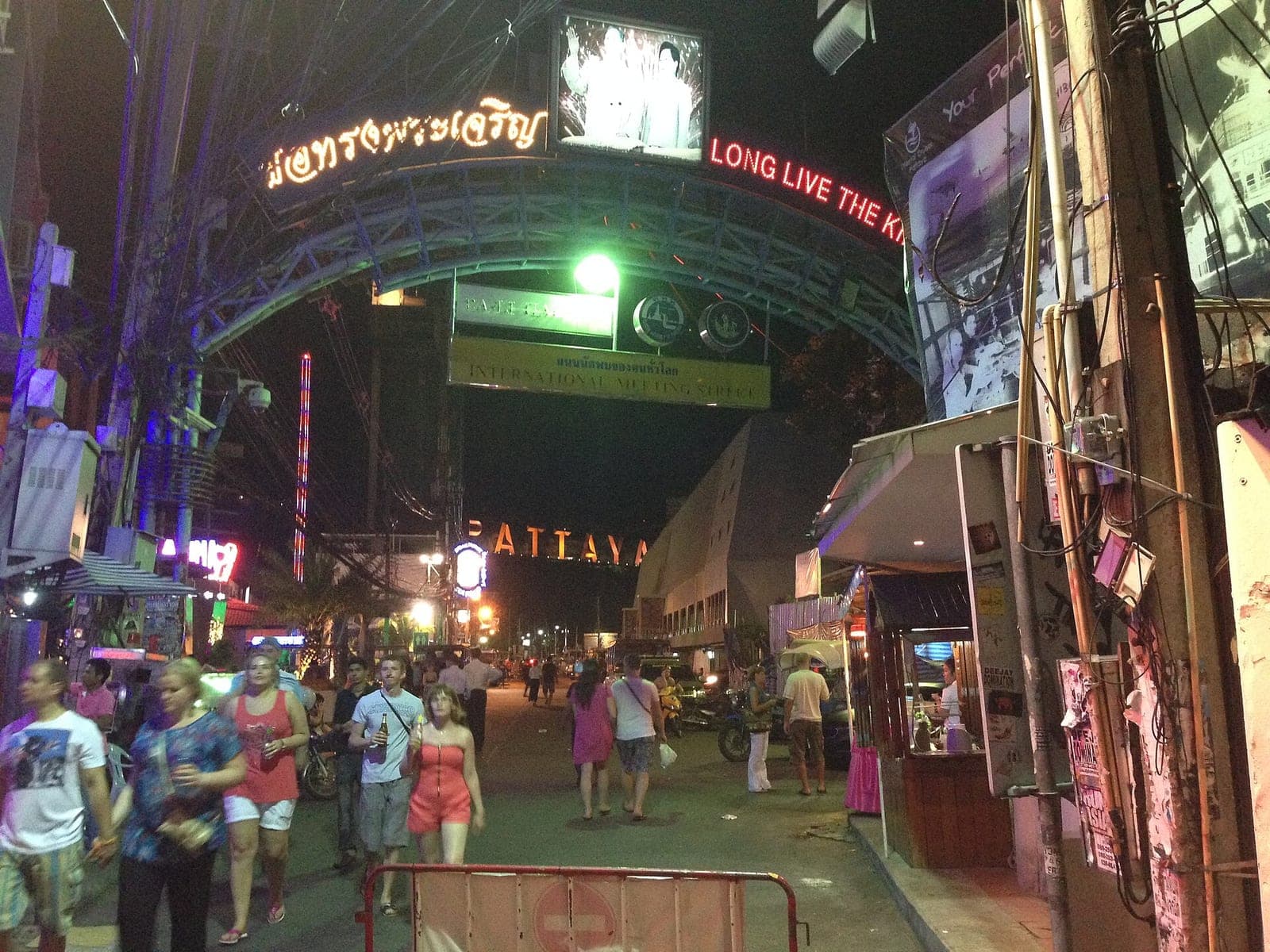
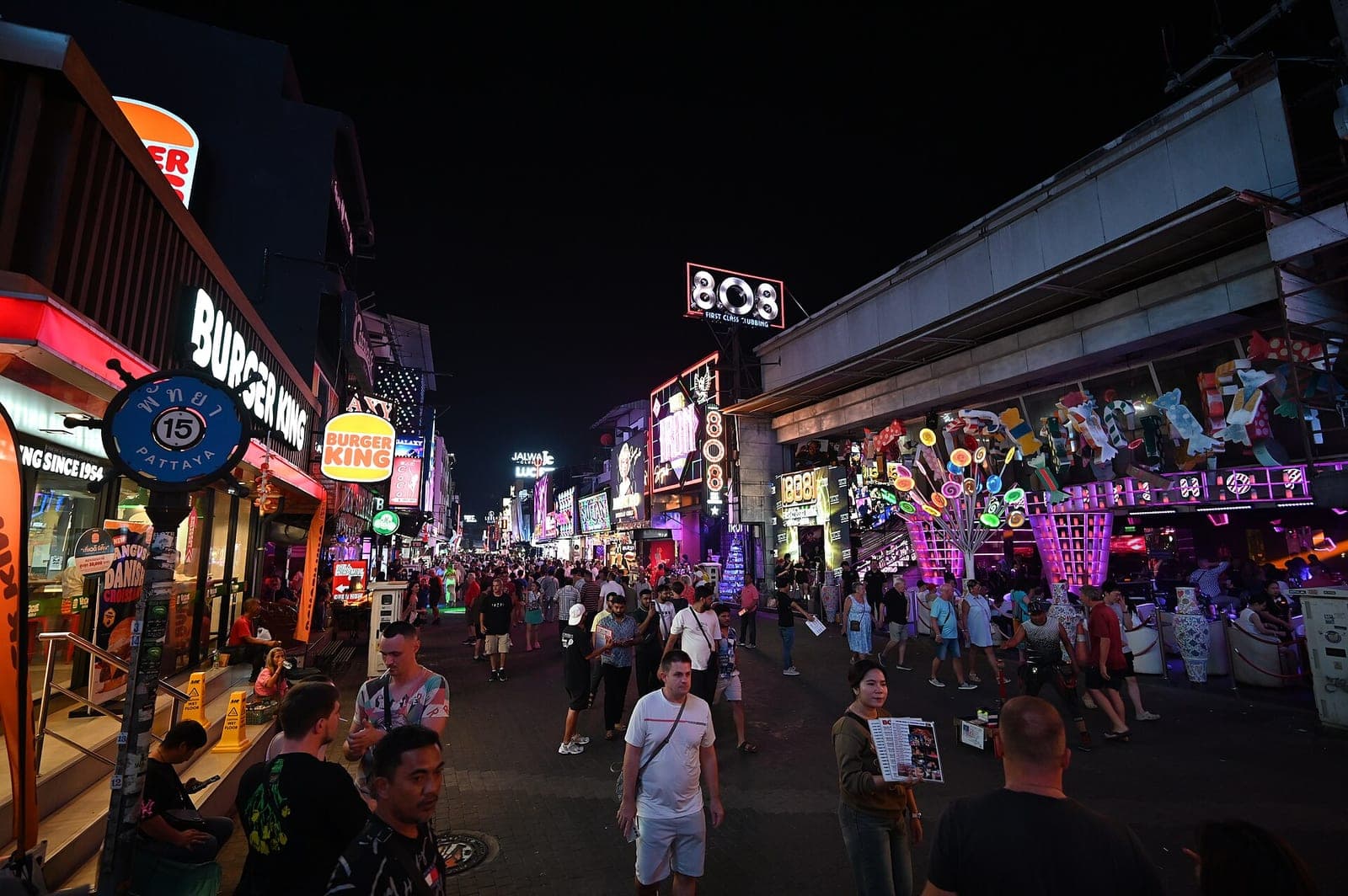
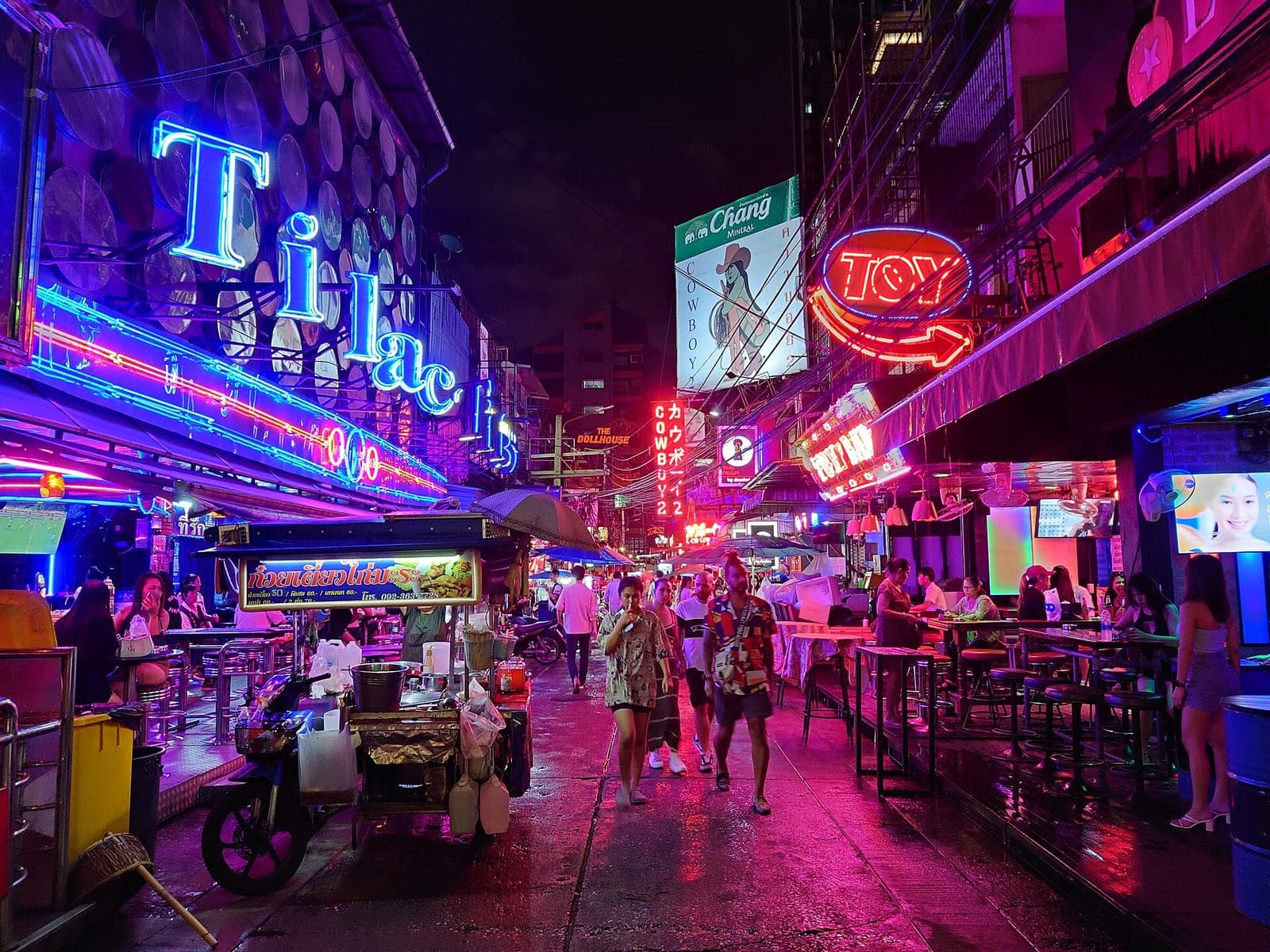
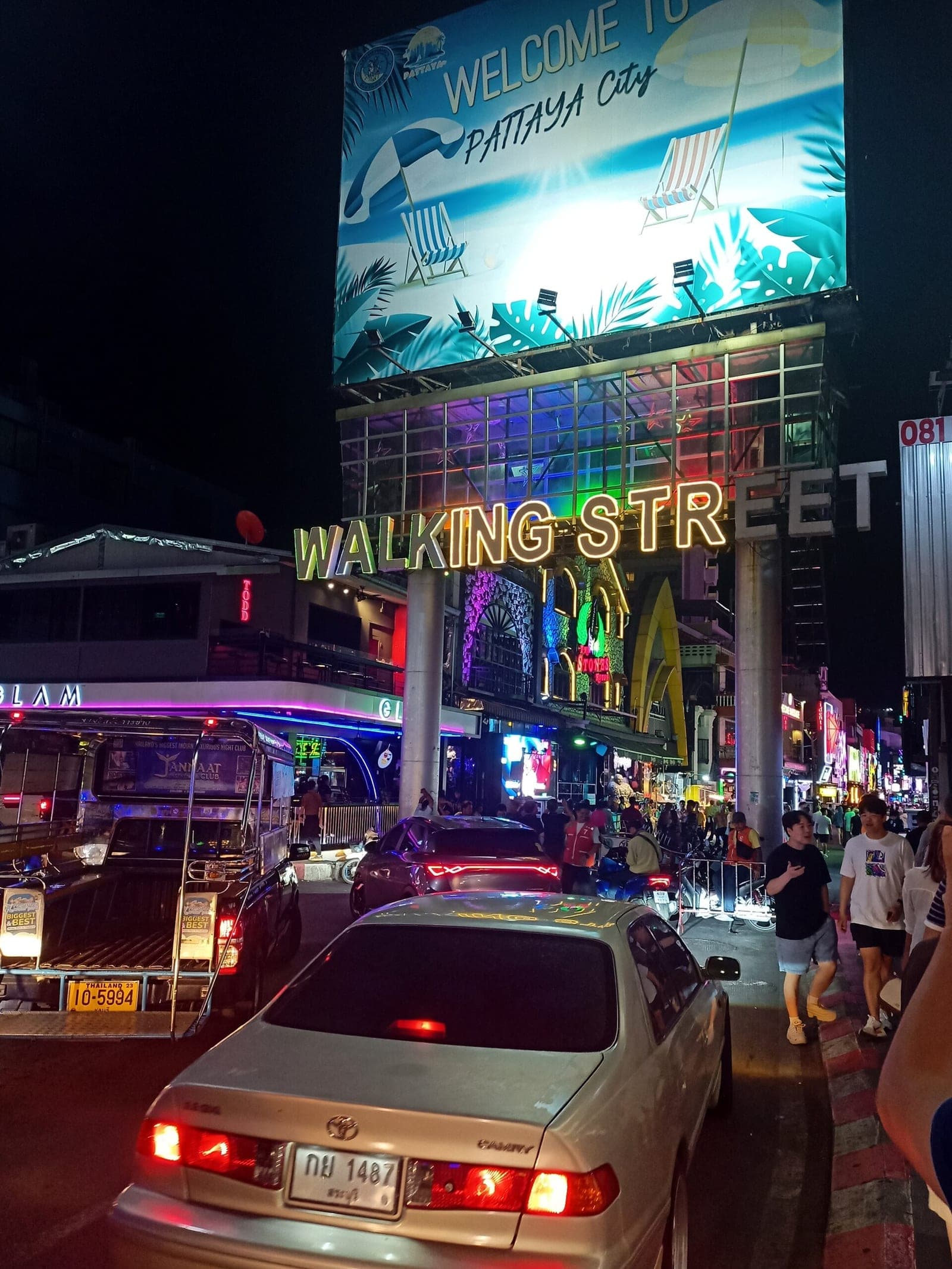
Pattaya on its own — Walking Street, Soi 6, LK Metro, Soi Buakhao, Soi 7 and Soi 8 and Jomtien — has more bars than the entire Philippine scene put together, and it is two hours from a capital city with three more nightlife districts of its own. Add Phuket's Bangla Road and the scene in Thailand is deep enough that a man could spend a month without repeating a street.
The Philippines concentrates. Walking Street (Angeles City) and Fields Avenue are the country's biggest go-go strip and you can walk the whole thing in fifteen minutes; P. Burgos Street is a few blocks in Makati; Cebu's Mango Square is one square. It is a smaller world, and after five or six nights you will be recognizing faces — which some men find limiting and others find is exactly the point.
Two structural differences matter more than the counts. Closing times: Thailand's bars in most zones shut at 01:00 or 02:00 by law, with a handful of extended-hours zones in Bangkok running to 04:00; Angeles City's ordinance puts last call around 03:00 and Manila varies by barangay. Style: Thailand's go-go bars are bigger, louder, more choreographed and more expensive; Philippine bars are smaller rooms where the women sit and talk to you, and the conversation is the product. The full mechanics are in How the bar scenes work, country by country: go-go bars, beer bars, ladies' drinks, mamasans and the bill.
Where is it easier to actually meet women?
The Philippines, and the reason is one word: English.
This is the single biggest difference between the two countries and it changes everything downstream. English is an official language of the Philippines, the medium of instruction in schools, and the working language of a call-center industry employing millions of young women. The woman on the next stool in Angeles, the nurse at the mall in Cebu, the saleswoman in Makati — all of them can hold a real conversation with you from the first minute, including the jokes, including the awkward bits. You will find out whether you like each other on night one instead of week three.
In Thailand you will do a great deal of talking through a translation app, some smiling, and a lot of guessing. That is not a tragedy — plenty of men have built long, happy marriages on a shared vocabulary of four hundred words — but it slows the whole process down and it filters what you can learn about someone. Bangkok's professional women and the bar women who have worked with foreigners for years are the exceptions; the rest of the country is not.
The second difference is the scene outside the bars. Both countries have huge populations of single women with ordinary jobs who will never go near a go-go bar, and in both countries the way you meet them in 2026 is online, before you land. The Philippines is easier here as well: no translation, a culture where meeting a foreigner is normal and unembarrassing, and a national first date — coffee at the mall, often with a friend along — that is cheap, public and comfortable. Meeting women outside the bars: malls, cafés, gyms, meetups and the rest of the town covers the daytime version, and Online dating before you fly: how the smart guys land with a date already booked covers the two-to-six-week run-up that most repeat visitors now treat as the actual trip planning.
Which is cheaper?
The Philippines, by roughly ten to fifteen percent on a typical week — but the two countries are cheap in different places, and the difference is smaller than the forums claim.
| Item | Thailand (Pattaya) | Philippines (Angeles City) |
|---|---|---|
| Beer in a bar | $2.5–3.5 (฿80–110) | $1.8–2.8 (₱100–160) |
| Ladies' drink | $4.5–7.5 (฿150–250) | $4.5–11 (₱250–600) |
| Budget room | $20–35 (฿650–1,150) | $22–40 (₱1,250–2,300) |
| Mid-range room with pool | $45–85 (฿1,500–2,800) | $45–85 (₱2,500–4,800) |
| Western main course | $8–15 (฿250–500) | $8–13 (₱450–700) |
| Street-food plate | $1.5–3 (฿50–80 / ₱80–150 / ₫40,000–70,000) | $1.5–3 (฿50–80 / ₱80–150 / ₫40,000–70,000) |
| Local transport hop | $0.45–0.60 (฿15–20) | $1–1.8 (₱60–100) |
| One hour of massage | $9–14 (฿300–450) | $6–10 (₱350–600) |
| Tourist SIM | $10–20 (฿300–700) | $9–20 (₱500–1,100) |
| Round trip from the US | $850–1,300 (US$850–1,300) | $850–1,400 (US$850–1,400) |
Where Thailand wins: food, at every level from a noodle stall to a proper restaurant. Domestic flights and long-distance buses. Massage, which is a daily habit for a lot of long-stay men and cheap enough to be one. Convenience stores, which are everywhere and stocked properly.
Where the Philippines wins: rooms, consistently. Beer, by a little. Anything involving labor — a haircut, a laundry, a driver. And the invisible saving of not needing a translator, a tour or a guide for anything.
Where they tie: the actual bar bill, which in both countries is set by how generous you feel rather than by the price list. A man buying drinks freely will spend the same in either country, and that line item dwarfs the rest. What a week actually costs: careful, normal and comfortable, city by city has the full week-by-week arithmetic.
One caution about exchange rates: figures on this site were set in August 2026 at roughly ฿32 and ₱57 to the dollar. Both currencies move, the peso more than the baht in recent years, and a five percent swing wipes out most of the gap between the countries.
Which is easier to get to from the States?
The Philippines, decisively, and it is the most underrated factor on this page.
Manila has nonstop service from Los Angeles, San Francisco, New York JFK, Seattle and Honolulu on Philippine Airlines, plus San Francisco on United — about fifteen hours from the West Coast, and you are through immigration and in a car within an hour of landing. Clark International Airport, twenty minutes from Angeles City, has no US nonstops but connects through Seoul, Tokyo, Hong Kong, Taipei, Singapore, Doha and Dubai, so a well-chosen one-stop routing puts you at the Fields Avenue arch without ever seeing Manila traffic.
Bangkok has no nonstop from the United States as of August 2026. Every routing is one stop — Tokyo, Seoul, Taipei, Hong Kong, Doha or Dubai — and totals nineteen to twenty-two hours from the West Coast, twenty to twenty-four from the East. Then, if Pattaya is the destination, you add a two-hour transfer at the end.
| Thailand | Philippines | |
|---|---|---|
| Nonstop from the US? | No | Yes — Manila from LAX, SFO, JFK, SEA, HNL |
| Typical door-to-door, West Coast | 22–26 hours to Pattaya | 17–19 hours to Angeles City |
| Round-trip fare (Aug 2026) | $850–1,300 (US$850–1,300) | $850–1,400 (US$850–1,400) |
| Arrival transfer | $40–55 (฿1,300–1,800), ~1h45 | $7–12 (₱400–700), 20–30 min |
| Getting between the two | $180–300 (US$180–300), 3.5 hours | Same flight, other direction |
The practical consequence for a man of sixty is worth stating plainly: the Philippines is one flight and a short drive, and Thailand is two flights, a long day and a bus. On a two-week trip that difference is a rounding error. On a ten-day trip it is a day and a half of your life.
Visas: which lets you stay longer?
The Philippines, and it is not close either.
Thailand gave US passports a 60-day visa exemption from July 2024; in May 2026 the cabinet approved cutting it back to 30 days for the US and around ninety other countries, with the change taking effect after publication in the Royal Gazette. As of August 2026 you may still be stamped in for 60, but plan for 30. Either way you get one 30-day extension at an immigration office for $58 (฿1,900), and everyone flying in must file the free Thailand Digital Arrival Card online in the three days before landing.
The Philippines stamps you in for 30 days free, and then extends you almost indefinitely: the first 29-day extension at any Bureau of Immigration office costs $53–56 (₱3,030–3,150), and further extensions in one-, two- and six-month blocks can take a tourist stay to 36 months. There is a Bureau office in Angeles, one in Clark, one in Makati and one in Cebu. You will also need the free eTravel registration before arrival and proof of an onward ticket, which the airline at your US departure gate genuinely enforces.
If you are testing whether you might live there — see Retiring in Southeast Asia: the visas, the money and the reality — the Philippines lets you stretch a tourist stay long enough to find out. Thailand makes you commit to a visa category. Full detail on both is on the Visas for US passport holders: country by country (2026) page.
Hotels, beaches and daytime: which is the better holiday?
Thailand, and if the trip is meant to be a holiday first and a scene second, that decides it.
Hotels. Both countries have good, cheap rooms near the bars. The difference is policy: in the Philippines, particularly Angeles City, the great majority of hotels near the scene register a visitor with photo ID and charge nothing, and everyone treats it as normal. In Thailand most hotels are relaxed but a minority — more of them in Bangkok and Phuket than in Pattaya — charge a joiner fee of around $10–30 (฿500–1,000 / ₱500–1,500) or decline visitors outright. Always check before you book; every hotel page on this site lists what is reported.
Beaches. The Philippines has the better beaches in absolute terms — Palawan, Boracay, Siargao, Bohol — and the worse access to them, because each one is another domestic flight and a boat. Thailand's beaches are merely excellent and sit on an expressway or a one-hour flight: Jomtien is a baht bus from Walking Street, and Phuket, Krabi and Koh Samui are an hour in the air. For a two-week trip built around nightlife, easy beats spectacular. Angeles City, it should be said plainly, has no beach at all; Subic Bay is an hour west.
Daytime. Thailand wins on food (decisively), temples, islands, massage, malls, golf and the sheer competence of the infrastructure — the Skytrain, the expressways, the hospitals. The Philippines wins on being able to ask anyone anything. Both have world-class private hospitals at a fraction of American prices, which matters more to our readership than most travel guides admit.
Which is safer?
Both are safe for a sensible adult, and each is dangerous in a different way.
Thailand's number one risk, by a wide margin, is the road. The motorbike accident rate is among the worst in the world, the rental scooter you are being offered is uninsured, and a serious crash will cost you far more than the trip. The scene risks are financial rather than physical: an inflated tab, a padded bill in a Patpong upstairs bar, a taxi with a broken meter. Violent crime against tourists is rare.
The Philippines' risks skew toward property and confidence: pickpocketing in a crowd, a tricycle fare that doubles on arrival, the "friendly stranger with a drink" scam in Manila, and the small but real gun culture that makes a drunken argument a worse idea than it is elsewhere. Angeles City has a 24-hour police station on Fields Avenue and a lit, busy strip; Manila requires more care, and Cebu somewhere between.
Both treat drugs as prison, not as a fine. Do not accept anything from anyone, do not carry anything for anyone, and treat a stranger offering you something in a nightlife district as a problem walking toward you. Typhoons hit the Philippines from June to November; Thailand's rainy season is wetter and less dramatic. Red flags and romance scams: the sick buffalo, the hospital bill and how to say no kindly covers the money side and the Safety in Southeast Asia: what actually goes wrong, and what to do about it page covers the rest.
Which is more likely to end in a relationship?
The Philippines, and the gap is larger than most men expect.
Shared language is most of it. The rest is culture: the Philippines is Catholic, family-first and marriage-minded in a way that has no real parallel in Thailand, there is still no divorce in the country, and a woman who is interested in you is usually interested in something more than a fortnight. The path from a first trip to messaging to a second trip to a K-1 or CR-1 petition is so well worn that both families will already know how it works — see Bringing her home: the K-1 and CR-1 visas, explained. The trade is that you are joining a family, not dating an individual, and the obligations that come with that are real and permanent.
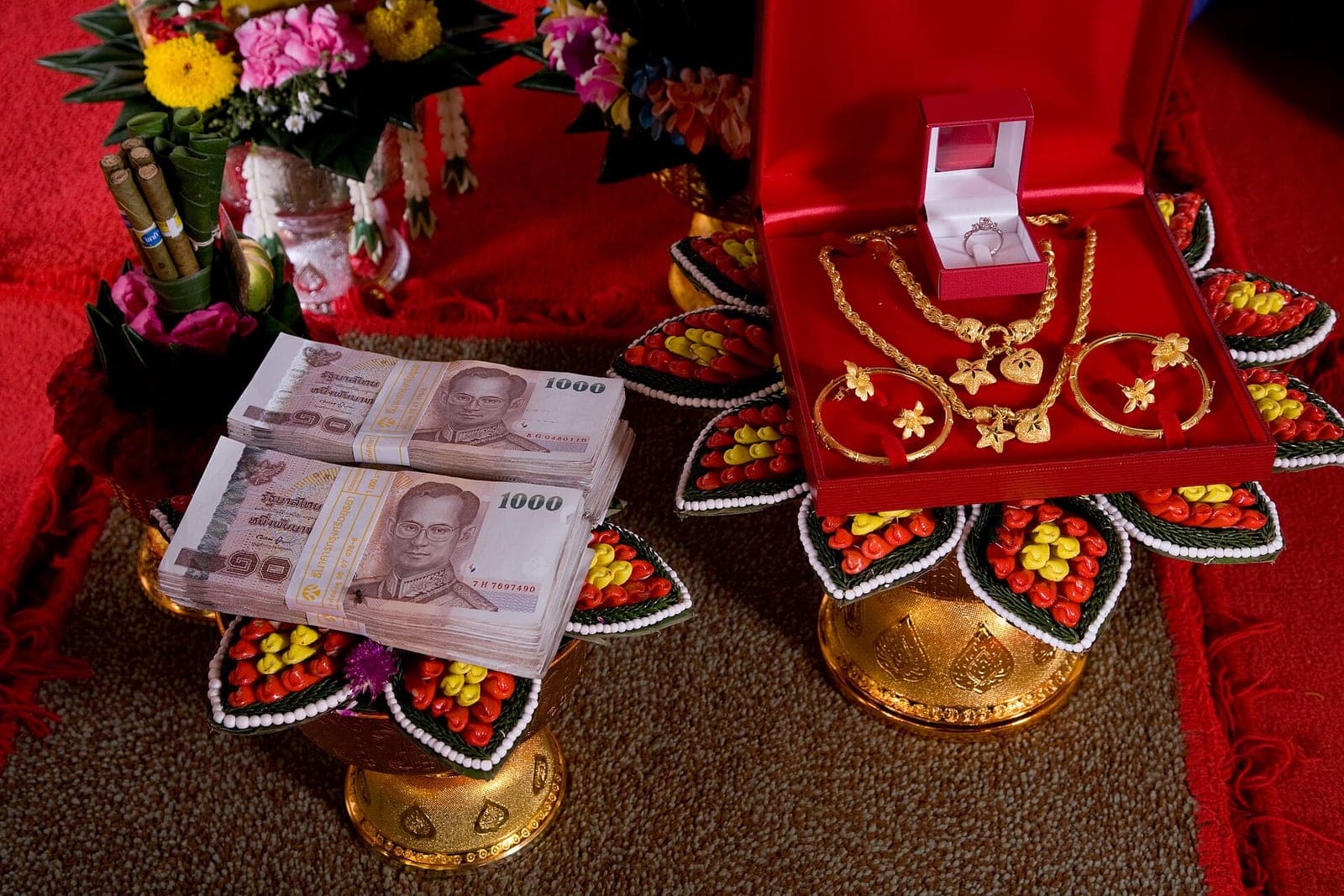
Thailand's version is slower and more oblique. Family obligation runs through money rather than through Sunday lunch; sin sod — the bride price — is a real negotiation in a way Americans find bewildering; and face makes disagreements hard to read. Plenty of Thai marriages to Western men work beautifully and last decades. They just take longer to build, and you will spend the first year genuinely uncertain what is being said. Dating culture by country: sin sod, utang na loob, face, family and the law lays out both properly.
Both countries share one honest caveat: an American income is transformative in either, the age gap is normal in both, and the same warmth that makes a place easy to fall for makes it easy to be taken in by the wrong person. That is not a national characteristic; it is arithmetic.
So which should you pick?
| If you are… | Go to | Because |
|---|---|---|
| A nervous first-timer over fifty | Philippines (Angeles City) | You can talk to everyone; the town is small and forgiving |
| After the biggest night of your life | Thailand (Pattaya) | Nothing in Asia matches Walking Street on a Saturday |
| On a tight budget | Philippines | Cheaper rooms and a cheaper flight from the West Coast |
| Bringing a beach holiday and a scene together | Thailand | Pattaya, Jomtien and Phuket within an hour or two |
| A foodie | Thailand | It is not close |
| Hoping to meet someone, not just meet everyone | Philippines | English, Catholic family culture, a known visa path |
| Short on time (10 days or fewer) | Philippines | You lose a day and a half less to airports |
| Thinking about living there eventually | Philippines for the language, Thailand for the infrastructure | Extend a Philippine tourist stay to three years and find out |
| Coming back for the third time | Both, in one trip | $180–300 (US$180–300) and 3.5 hours between them |
Our house answer, for a man who has never done this and wants one recommendation: the Philippines, Angeles City, ten days. English makes the first trip survivable, the town is small enough to learn in three nights, Clark airport is twenty minutes away, and the rooms are cheap enough that you can afford to be wrong about anything else. Then go to Pattaya next time and see the other thing.
And whichever way you go, the men who come home saying it was the best trip of their lives are almost always the ones who had already been talking to two or three women for a few weeks before they landed.  Start those conversations before you book — the practical version is in Online dating before you fly: how the smart guys land with a date already booked, and the city-level decision is in Pattaya vs Angeles City: which one first?.